Our Technology
At the intersection of geographic science, precision fabrication, and interpretive art — our process transforms raw terrain data into immersive physical experiences.

Luminous Cartographs
Our Luminous Cartograph technology uses projected light to create dynamic visualizations on the surface of a 3D terrain model. Visitors can cycle through views showing elevation, geological strata, light and shadow movement, historical events like wildfires, simulated weather, and seasonal changes — all controlled via touchscreen.
This technology bridges the gap between physical and digital mapping, offering an interactive experience that static maps cannot provide. Our first Luminous Cartograph is on permanent display at the Waterton Lakes National Park visitor centre.

GIS Data Processing
Every map begins with high-resolution geographic information system (GIS) data. We source digital elevation models (DEMs), bathymetric surveys, and satellite imagery to build an accurate digital representation of the terrain. This data is processed to determine optimal scale, vertical exaggeration, and the geographic extent of the final model.
Cartographic scale represents the relationship between model size and real-world terrain. Scale choices involve trade-offs between detail visibility, relief height, and geographic area coverage.

CNC Milling
Digital terrain models are translated into toolpaths for computer numerical control (CNC) milling machines. High-density foam or wood substrates are carved with sub-millimeter precision, capturing every ridge, valley, and coastal contour of the landscape.
Multi-axis milling allows us to reproduce complex overhangs and steep terrain features that would be impossible with simple 2.5D cutting.

3D Printing
For certain projects, stereolithography (SLA) or fused deposition modeling (FDM) 3D printing is used to produce terrain models or small-scale interpretive elements. This is especially valuable for complex geometries like cave systems or intricate coastal features.
Small relief maps available through our Etsy store are produced using high-resolution 3D printing at scales suitable for desktop display.

Hand Finishing & Painting
Skilled painters apply terrain coloring, vegetation textures, water features, and interpretive elements by hand. This process transforms a raw CNC-carved blank into a vivid, accurate representation of the landscape.
Decorative icons mark viewpoints, campsites, and cultural sites. Hiking trails are color-coded by difficulty. Place names appear in multiple languages where culturally appropriate.
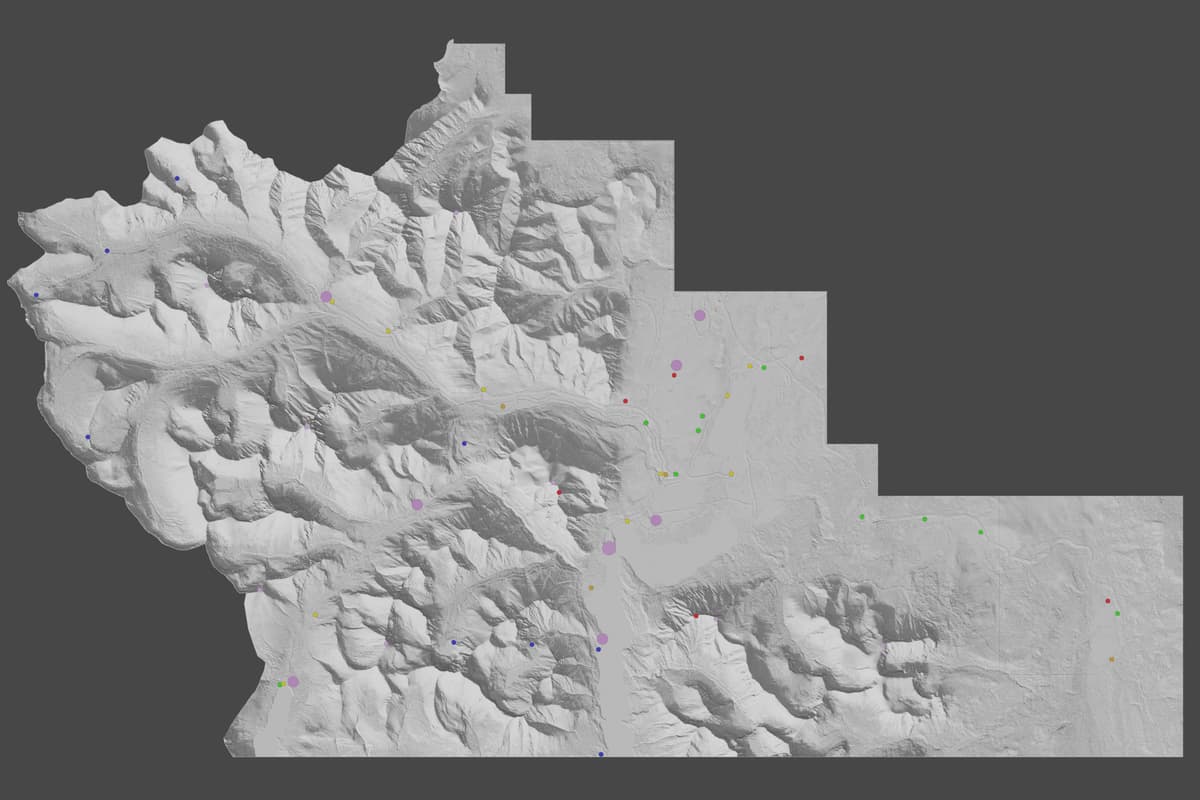
Interactive Digital Overlays
Many of our installations incorporate embedded LEDs connected to push buttons, allowing visitors to illuminate specific features — mountain peaks, cultural sites, or geographic boundaries. Legends and labels can be presented in multiple languages, including Indigenous languages.
Button-activated lighting systems are engineered to be durable for high-traffic public installations while remaining intuitive for visitors of all ages.
See the Results
Explore our portfolio of completed projects — from national park installations to private commissions.
Our Work →